
Interview with the Playwright: Mario Correa (N/A: A New Play)
Edited for length and clarity by
Moira O’Sullivan (Literary & Artistic Coordinator)
Moira O’Sullivan: What was your initial inspiration for the show?
Mario Correa: Well, I guess if I really go back to my initial, initial inspiration, it is the fact that I was a very young staffer to a woman who was a member of Congress in my high school days. She was running for Congress. She was a professor of English at our local community college, and she was making a very long-shot run for Congress, and when she knocked on our door, nobody in my house was a citizen at the time, including myself, but I just thought she was cool. And so I said, I’ll help you on your campaign. I don’t know why I did that, but I did. And so we ran this campaign, and she shockingly won. And so all of a sudden, she was going to Congress, and she offered for a few of us from the campaign to go to the Hill. I was going into my senior year in high school, actually, I was that young, and I switched my college plans to stay local so that I could continue to work for her during college. And then after college, I went back and worked full time for her as a staffer for another three years or so. So by the time I was like, 23 or 24, I had done seven years on Capitol Hill, which is a crazy thing. Very much like Gary on Veep, I started, like, carrying her purse, I was her driver. And then I ended up advising her on real things and being a proper adult.
I learned so much from her. She was an Italian American woman, a mom, she had sort of come into her own during the women’s movement in the 1970s and I was observing how she was making her way in this institution that was really not built for women, certainly not women in midlife. And when my boss was elected, shortly thereafter, Nancy Pelosi was elected to Congress in a special election, so she was there when my boss was there.
And so years later, after I had left the Hill, I ended up really doing what I wanted to do, which was becoming a playwright. Fast forward some 15-20 years, it was during COVID, and I was thinking, oh my gosh, what’s the theater going to look like when, or if, it comes back? And I thought to myself: I want to write a play where two characters never touch each other on stage. It’s obviously going to be some kind of discussion. They’re going to circle each other the whole time. It was sort of the idea of how can we create something that we can actually do and be back in a theater again? And so I thought, Oh, what are two characters who are sort of at odds and can never quite connect? And then my mind went to the relationship between Nancy Pelosi and Alexandria Ocasio Cortez, which had always fascinated me just because of my former Hill time. And that’s how it began. So it began really as a COVID need, and then once we were through that, it developed into just me pursuing my passion for these and other women who served in Congress.
MO: It’s so interesting because it really is an incredibly producible play, because it is just two characters in one room, but you’ve taken that and then used that pressure cooker of an environment to really create high stakes.
MC: You know, it’s funny. I didn’t realize how hard it is to write a two-hander. I’ve been told by other playwrights, but I was like, how hard can it be? But the reality is, when you only have two people on stage, all of the momentum, all the raising of the stakes and any resolution of any questions, all has to be generated only by them. I use a couple interruptions from phone calls and things like that to move certain things along, but you’ve really got to figure out how to propel it. And it was harder than I ever imagined.
MO: There’s nowhere to hide in a two person play, there’s no third party that’s going to come in with some big breaking news. If you storm out, that’s the end of the scene, you know, so how you keep them in the room and keep them moving the story forward is really hard, and you do a great job of that.
MC: Oh, thank you. No, it was, and I remember one time when I realized we could have a phone ring, I’m like, Oh my God, thank God for a phone! Because you’re so in it, that you forget that there are ways to give us a breath, you know?
MO: And a reminder that there’s a world outside of this, yeah. You touched on your previous experience working as a congressional aide. What about that helped throughout your writing process? Did it give you an inside perspective that others might not have?
MC: Yeah, it definitely did. The one thing that I hope comes through is these women do talk to each other the way Congress members talk to each other. I did not try to simplify things. I wanted to give enough context that the audience knows what was going on, but the terms they use to refer to certain things, the dynamics of how members trade for votes, all of that was really very close to what I observed.
You know, I remember this time in the 90s, there was a right wing Congressman named Tom DeLay, who was running to be the Republican whip, and he was a really problematic guy. My boss was a very progressive Republican. Today, you don’t see them, but at the time, there were a few. And I remember he came to solicit her vote for Republican whip, and he was sitting in her waiting room, almost like a dentist office, you know, just kind of cooling his heels. Wasn’t making phone calls, I don’t think there was an iPhone yet. So he was just kind of sitting there, like expectantly. And I thought this was so weird, how this guy, who was likely going to be like the whip anyway, who has a lot of power, was coming kind of hat in hand to my boss, a much more junior member who disagreed with him on a lot of fundamental issues, to get her vote. And that I always thought was an interesting thing that stayed with me, because in the play when N needs A’s vote to become Speaker, it’s a very uncomfortable position for a very senior member who’s already been Speaker and has accomplished so much. She has to ask this woman, who is not only young, but just off the street. I mean, it’s been days since she’s even been sworn in. She’s yet to cast a vote. It’s not a comfortable place to be in. And that was sort of the inspiration for that scene. And there are other things that pop up in the play that came from that experience of being there watching it.
MO: Yeah, it’s fascinating to see the status shifts throughout it, because it doesn’t stay consistent. It’s not like N is always in control. To see the way that the scales tip is really exciting.
MC: I’m glad that you feel that way, because it is really important to me, and you know, it’s funny.
Well, there are a lot of jokes in the play. When we did our premier production here in New York, our wonderful director Diane Paulus would always say, you have to tell people it’s funny because that’s not the expectation when you walk into a play about politics or the state of the country.
A lot of the jokes in the beginning are the older character kind of smacking a little bit at the sort of young whippersnapper. And I got comments about that, and that made me laugh a little bit, because I was like, can you imagine a world where a 28 year old newbie is smacking at the much more senior veteran, former Speaker of the House?
So I had to create a situation where the younger character earns the right to start smacking back, you know, and that’s her trajectory in the play, or the intention. And it takes a while because she’s gotta earn it.
MO: Yeah, I think, as someone in AOC’s generation, I’m constantly feeling like I want people to take me seriously and I want to be respected and treated like I know what I’m talking about, but you have to continue to prove yourself. And it is nice to see a character go through that arc, and you see her find her power and her strength.
MC: I hope that this is something that the actors are discovering [at Barrington], that parts of it are uncomfortable for each of these women. Neither woman is perfect and I think each is held to account in certain ways.
MO: What are the unique challenges to writing a play inspired by real people, but who are not actually them?
MC: One of the big challenges is that people in the audience have a strong feeling about those people and events to begin with, so you are taking something that is known to them and that many of them have made a decision about, and you’re asking them to open their minds to how it may have come to pass or to the different viewpoints that may have been put forward in these behind-closed-doors conversations. The challenge is getting people to separate what they think they know about real life people, and to participate in a little bit of imagining it with you. What I’m hoping to do is to illuminate real life people through these fictionalized characters, but nothing in the play radically changes who these women are. It just illuminates who they are. And I get asked, you know, why not name them? And it is a totally fair question. And I have gone back and forth about that, and the long and short is, I didn’t want directors or actors to feel too bound by history. You know, this is not a history play.
MO: Right, it’s not like they’re doing their impressions of these people, there’s some freedom here to create a character that behaves in this way and believes all these things but doesn’t speak or walk exactly like someone else.
MC: And you know, the funny thing about it too is that the real life Nancy Pelosi is sort of a choppy talker, like you wouldn’t want to listen to it for 90 minutes, even when what she says is brilliant, while the real life AOC is an amazing orator, and so you would have started with a very unequal balance. The real Pelosi is so disciplined, so on message– reporters often complain about interviewing her, because she will not get off message and she’s not gonna give you a fun little anecdote.
MO: It’s so interesting, comparatively, to AOC, who when you give her an Instagram Live, she is off and running, and you can’t stop watching.
MC: It is astonishing to watch her. I still marvel. It’s funny how they have such different skill sets. I think they’re both brilliant, and I don’t think they’re as different from each other as the initial impressions would lead you to believe. But they have very different talents.
MO: They’re natural foils, it makes so much sense on stage. How did you go about making sure that it felt balanced? How did you ensure both perspectives felt substantial and justified?
MC: I think in the beginning that was my biggest fear about it, and I think that I came into it with a very institutionalist take on things. I worked on the Hill, and I saw the processes, and I generally, at the time, sort of believed in the process, and so I was naturally inclined to that. But I’m also Latino. I’m an immigrant, and the world has changed a lot since I was on the Hill and I really welcome this breath of fresh air that the real life AOC brought. So I just wrote it as honestly as I could. But, when you have an intergenerational dialogue, you are not going to start as equals. You can’t. The very nature of an elder speaking to a junior is going to be unbalanced for a while, until that junior earns her right to sort of be on the same level. And that is hard in a play, because it can read as she’s getting a lot of pot shots, you know?
And so I wanted to be sure that when the dynamic shifts in the play, it is really earned. I couldn’t make them equals by language… What I had to do was to give the younger character the moral high ground, which I think she really does occupy. I was really comfortable with that trajectory. The elder can have all the quips she wants and make some good points, but at the end of the day, if she can’t hold on to the moral high ground, if this younger woman has essentially shown that she is doing the right thing, then the balance of the play has really shifted.
MO: It’s fascinating to see one character who really lives in the system, works the system based on the mechanics of it, and then someone else who works with emotion and humanity. The clash is inherently going to be there.
When we programmed this it was pre election, and since then, the world has changed so much, and we at the theater had to sort of anticipate what people were going to want to see or be ready to see. So I’m just curious what you think about doing this play now and what you hope audiences take away from it?
MC: The first thing I want to say is I want to thank Barrington for doing this. I think it takes a certain not insubstantial bravery to ask people to listen to a play about how distressing our time is at a time when our country is incredibly distressing. That is why I also emphasize there are a lot of laughs in the play!
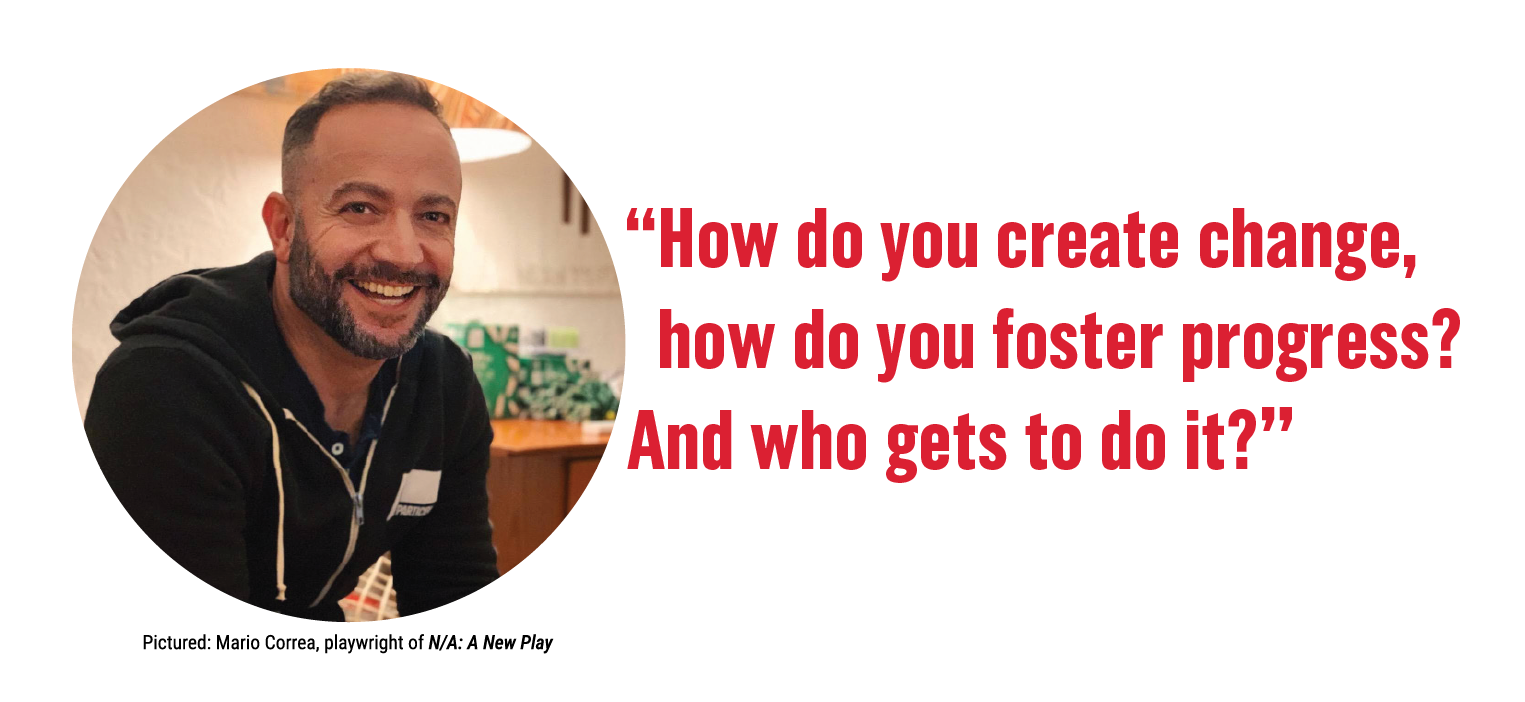
Secondly, it’s funny. I wanted the play to really be an intergenerational dialog of two women who have come into their own power in very different ways. And I wanted that to outlast the times, right? So one of the things that I think is really exciting about Barrington doing it this year is that we have moved forward beyond the election, and the issues that the play raises are basically the same as when we did this before the election, because there will always be the question of, how do you create change, how do you foster progress? And who gets to do it?
MO: Everyone is very impassioned these days. But I do think that the Democrats have so much infighting, and so much of it is these really differing ideas of how to do the right thing and to see that on stage, and be able to understand both sides a little bit more, maybe that will lead to some more unity.
MC: I think you put it better than I did, which is that right now, Democrats are really struggling with, how do we fight, do we work within the system, because the system is holding together, or do we just say, you know what? All bets are off? That fight is happening between like, a Chuck Schumer type and a Chris Murphy type, you know. And so that question is really the central question of the play: How do we fight?
MO: Right, because it’s never over and it’s always going to be evolving. And the play doesn’t answer the question, but I do think it gets people thinking in a different way, which is exactly what theater should do, as far as I’m concerned.
MC: No, exactly. It’s funny. An earlier version of the play when I was first writing it had an ending where they sort of come together more. And my agent, Jonathan Loma at WME, said to me, you know, you can’t resolve this for the audience. You have to allow them to leave that theater and argue amongst themselves in the lobby. And it is such a simple thing, but I can’t believe that I messed it up on the first go around. So yes, there’s no resolution.
MO: And in real life, we’re still waiting on one as well, haha.
MC: Yeah, so I think in the play, hopefully we see where things are going and the future we hold, but there’s not a path like, let’s sit down and be friends from here on out, type thing, you know, which [Pelosi and AOC] are not in real life.
MO: Well, this has been lovely and I’m excited for you to get to see a new version and see how it evolves.
MC: That’s when your play takes life right? I think only with a second production do you realize oh, this thing lives, it has a life of its own, it’s not a time capsule.
MO: You can actually see what you have. Someone once told me that new plays are never actually “done” until the third production, which, maybe on paper everything is the same, but it is just interesting.You don’t really know what you have until you’ve seen it in many different hands. And that’s what’s kind of wild about theater, is you have to be like, okay, go for it, let’s see what you do.
MC: I am so relieved now to not be in the rehearsal room this time. You know, this is the real test!
N/A: A New Play will be on the St. Germain Stage June 3-22.

Sponsored by Ed & Carla Slomin
N/A: A NEW PLAY
By MARIO CORREA
Directed by KATIE BIRENBOIM
Starring DIANE GUERRERO and KELLY LESTER
JUNE 4–22 | ST. GERMAIN STAGE
Be a fly on the wall for a riveting Congressional clash of wills. N/A takes you inside a battle of ideals behind closed doors between N, the first woman Speaker of the House, and A, the youngest woman ever elected to Congress. Inspired by real-life political leaders and events, this witty and whip-smart two-hander lets you see the sparks fly when a trailblazer and a firebrand collide.
Sponsored in part by
Jeffrey Davis & Michael Miller,
Carol & Al Maynard